
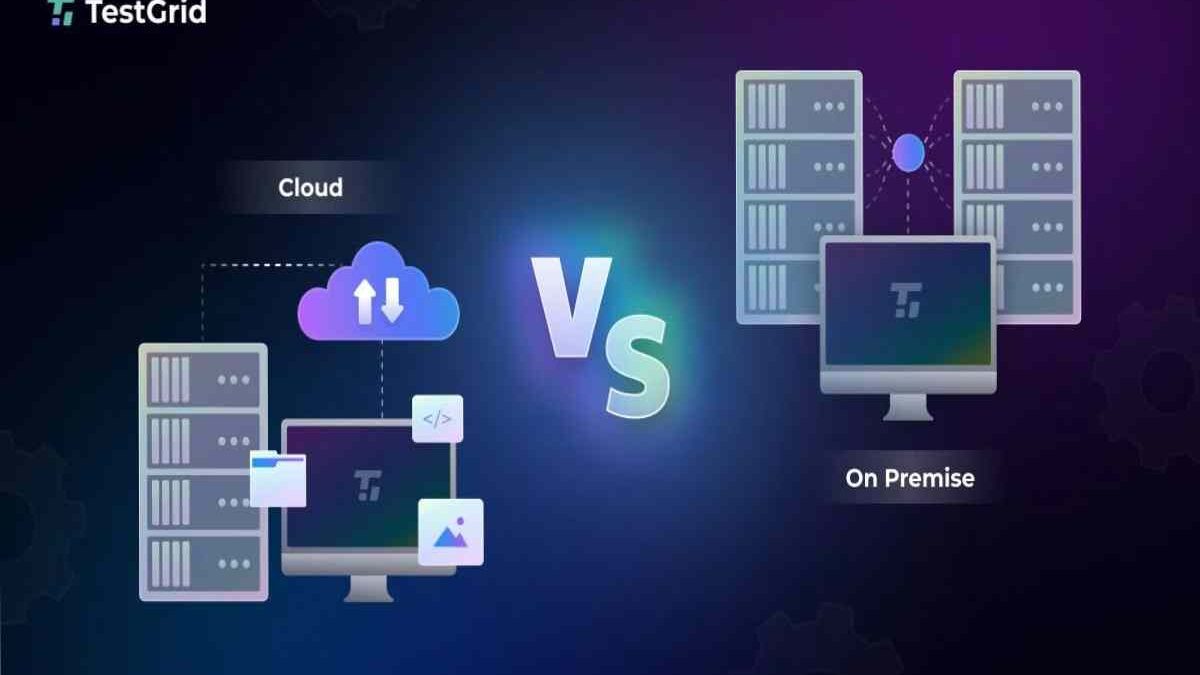
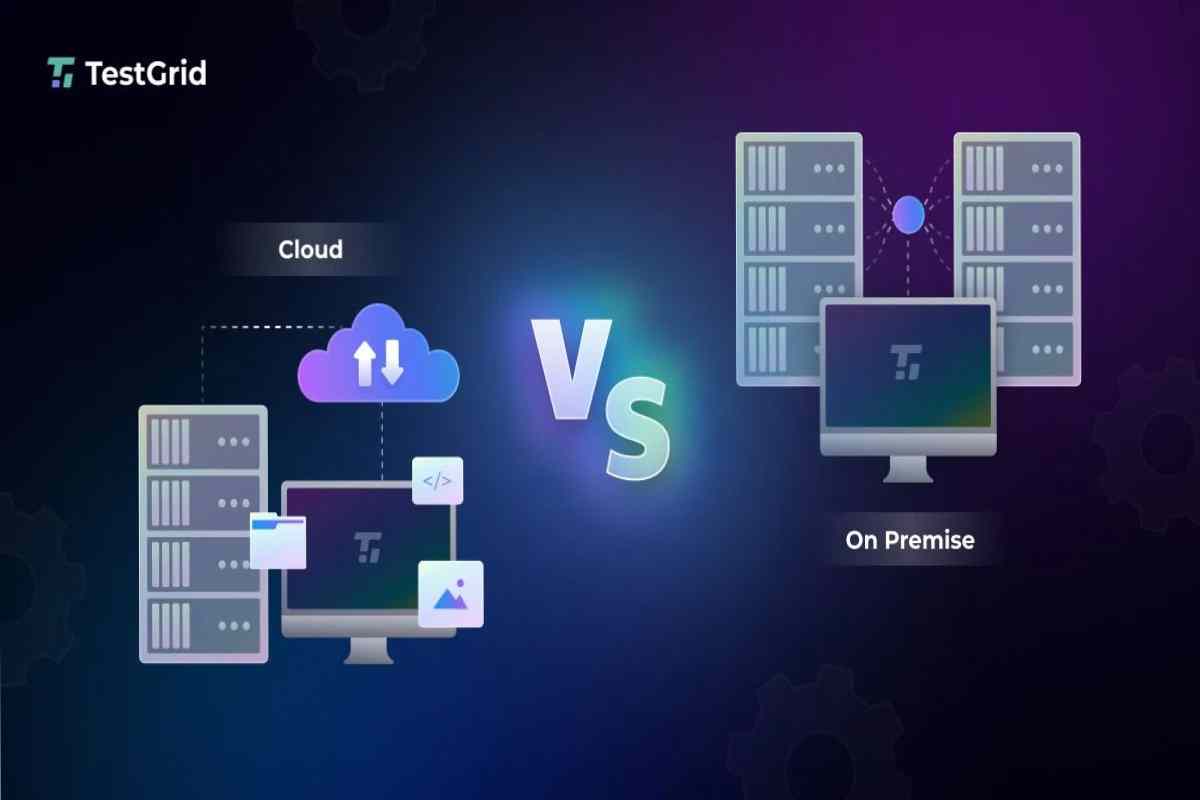
Businesses are at a crossroads with the decision to opt for cloud-based software or on-premise solutions. They need to consider factors such as security requirements, operational control, cost predictability, and scalability in the context of a hybrid work model and data sovereignty. For instance, a cloud solution like AWS Storage Gateway can provide easy hybrid access to S3 buckets for insurance claims processing, whereas a completely SaaS tool like Salesforce can help a company to streamline its sales pipeline without the need for any hardware. In contrast, on-premise systems allow a user to have complete customization for highly specialized applications such as advanced claims adjudication software or employee monitoring platforms, but they come with a higher upfront investment.
Table of Contents
Core Differences in Deployment Model
Cloud vs on‑premise software is basically a service that is provided by a remote provider and the software itself is run on the provider infrastructure. Access to it is done via an internet connection and thus it is available to everyone at all times (SaaS, PaaS, IaaS). The on-premise solution is set up on servers which are physically located in data centres or your offices. It requires Capex for the purchasing of the necessary hardware, licenses, and ongoing maintenance of the solution. Hybrid is a solution that involves using both the on-prem and cloud solutions: with AWS Storage Gateway data is temporarily stored locally to ensure low-latency claims queries and it then gets synchronized with S3 while the on-prem control stays.
Security: Control vs. Shared Responsibility
On-premises solutions are very good when it comes to data sovereignty. Full admin access gives you the opportunity to have air-gapped networks, custom firewalls, and compliance like HIPAA without the involvement of third-party auditors, which makes it an ideal choice for sensitive insurance claims systems that handle PII. Some of the disadvantages are that the system is completely vulnerable to the threat of insider attacks or ransomware without provider SOC monitoring; also if patching is done, it might lag when there is no 24/7 team support.
Cloud guarantees that security is a shared responsibility model: AWS takes care of the physical security of the infrastructure (durability is 99.999999999% of cases), customers should configure IAM policies and encryption – in case of a mistake like publicly opening an S3 bucket data confidentiality will be compromised. SaaS such as Workday ensures that compliance like SOC 2, GDPR are met by automating the process, but if the vendor gets attacked then the (e.g., 2023 Okta incident) effects reach everywhere. Advantage for heavily regulated sectors: On-prem for the most stringent control; cloud combined with VPC peering for secure hybrids.
Control and Customization Capabilities
The on-premise solution gives you the possibility of custom tailoring to the maximum extent- you can change the source code of the claims engine to integrate it with legacy mainframes or install a monitoring program like Teramind that helps processes video analysis with GPU acceleration. There is no vendor lock-in; you can interfase with any API you like without the restrictions of the marketplace.
Cloud concentrates more on the aspects of standardization: SaaS ensures that the UI is the same for all the users but if there is a need for a specific logic then developers have to use low-code extensions (e.g., AWS Lambda for claims workflows). Storage Gateway allows on-prem applications to access huge S3 datasets smoothly without any interruption, thus combining the advantage of control with that of elasticity. The final decision: On-prem for specific verticals; cloud for 80% of standard cases.
Cost Structures: CapEx vs. OpEx Breakdown
On-premise technology requires you to spend $500K or more just for the first couple of years on different equipment like servers, racks, and cooling that should be replaced every 3 years. In addition to that, you should budget $100K per year for the operating costs of power and staff; thus, the TCO will be stable after Year 3 and it will work for steady workloads.
On the other hand, cloud has only OpEx costs: pay for what you use with AWS (e.g., $0.023/GB for S3 storage) and you can even go down to zero during the off-season, but if you do a lot of extracts, there will be a lot of egress fees ($0.09/GB), and there will be some premium tiers that will be costlier for heavy claims archiving.
| Category | On-Premise (3-Year TCO, Mid-Size Firm) | Cloud (AWS/SaaS Hybrid) |
| Upfront CapEx | $750K (hardware/licenses) | $50K (migration/tools) |
| Annual OpEx | $200K (power/staff) | $300K (usage/subscriptions) |
| Scaling Cost | $250K/server cluster | $0.10/GB processed |
| Year 5 TCO Savings | Stable at $1.2M | $1.1M (elasticity offsets) |
Example of insurance:
On-prem laptop for claims ($300K) vs. AWS Outposts ($150K + $120K/year)—cloud wins for variable catastrophe volumes.
Scalability and Performance Trade-offs
Cloud has the ability to automatically scale its resources: for instance. AWS EC2 fleets will increase their capacity 10-fold for flood claims and after the work is done they will shut down by themselves, thus only 30% of the total capacity will remain and the saving of 70% will be realized. A tool such as Guidewire works with ease to process a million policies without the need for any major upgrade. Meanwhile, an on-prem system will be limited by the rack space; hence, to cope with demand at peaks overprovisioning will be implemented thus 30-50% of the capacity will be wasted.
In terms of latency, it is better to have on-prem for local apps (1 ms instead of 50 ms for RTR in the cloud), which is very important for real-time monitoring dashboards. Hybrids diminish the gap: Storage Gateway is capable of delivering S3 at local speeds with the help of NVMe caching.
Real-World Examples Across Industries
Insurance Claims
On-prem legacy systems (e.g., Duck Creek) process structured data securely. AWS Storage Gateway federates to S3 Glacier for 10-year archives at $0.004/GB/month, cutting retrieval 90%.
Employee Monitoring:
On-prem Teramind records 4K screens locally (zero latency); cloud alternatives like ActivTrak SaaS scale to 10K agents sans servers.
SaaS Benchmarks:
Rippling HRMS deploys globally in days ($10/user/month); on-prem PeopleSoft requires $2M installs.
Migration Strategies and Hybrid Wins Lift-and-shift of the VMs to EC2 remain done via AWS Migration Hub. Refactor to get serverless claims APIs on Lambda that slash the cost by 40%. With Storage Gateway Hybrid mode, hot data is cached on-prem and cloud remains used for the overflow. This is a great solution for regulated hybrids that keep PHI locally while scalable analytics remains carried out.
Gartner forecasts for 2025 that the majority of companies (65%) will adopt hybrid strategies. That allow them to enjoy the benefits of cost savings (30%) while being compliant.
Decision Framework Decision to use On-Premise:
Profoundly secure units (e.g. defense claims), allowed for fixed workloads, >5-year stability.
Decision to use Cloud:
New businesses, variable demand (seasonal insurance), teams operating worldwide.
Hybrid Sweet Spot:
The vast majority of tasks (80%) can remain done with AWS Storage Gateway — the perfect combination of control and elasticity.
In the long run:
Cloud TCO is slightly more expensive after the fourth year for expansion. On-prem is better for regulated industries that are in a state of stagnation. Monitoring of the utilization should be done on a quarterly basis; hybrids can be piloted via AWS Free Tier. These models do not compete with each other. Strategic blends are the way to go to have a resilient IT in the midst of economic fluctuations.