
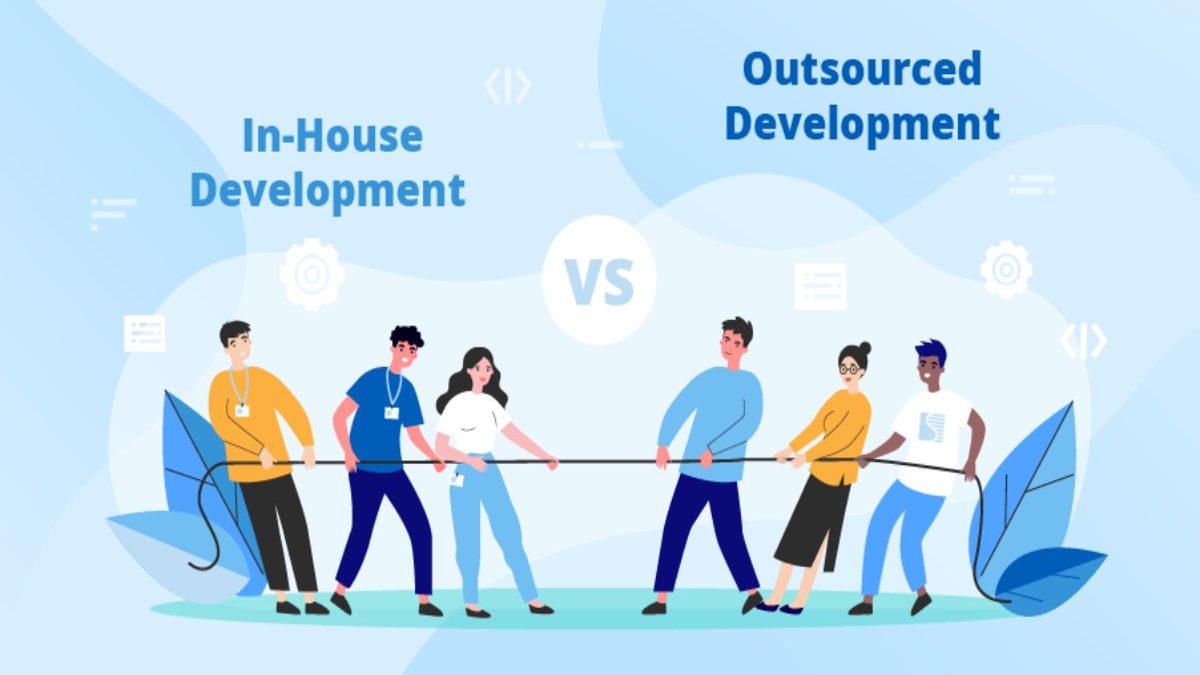
Are you wondering if hiring a python software development company is a good idea? You keep asking yourself, what is more profitable: An in-house or outsourced development team? Deciding which option suits your needs more is difficult for you?
If you want to know the advantages and disadvantages of hiring in-house vs. an outsourced development team, you should start by acquainting yourself with the main differences.
Table of Contents
What Do We Mean by Internal vs Outsourced Development?
-
Internal (In-House) Team: Your own employees work on the project full-time within your company.
-
Outsourced Team: An external company or contractor builds or manages the software on your behalf — locally, offshore, or nearshore.
1. Cost Comparison: Which Is More Affordable?
In-House Development: Higher Long-Term Costs
When you build an internal team, you’re responsible for:
✅ Salaries and benefits
✅ Recruiting and onboarding
✅ Office space, infrastructure & equipment
✅ Software licenses and ongoing training
✅ Administrative overhead (HR, management, facilities)
All these can make in-house development significantly more expensive — sometimes two to three times higher than outsourcing, especially for early-stage companies or small teams.
This model also carries fixed costs even when there’s no development work — meaning you pay developers whether they’re actively coding or not.
Outsourced Development: More Predictable & Lower Costs
Outsourcing generally offers:
✔ Clear project pricing or hourly rates
✔ No long-term salary commitments
✔ No internal recruitment costs
✔ No need for internal infrastructure
For strict budgets — particularly for small and medium-sized businesses — outsourcing is usually more cost-effective because you only pay for what you need, when you need it.
That said, outsourcing isn’t guaranteed to be cheaper if scope isn’t clearly defined or if management is weak — costs can rise due to scope changes or extra coordination.
2. Control, Communication & Quality
Internal Team: Better Control and Alignment
Having developers inside your organization means:
✔ Easier face-to-face communication
✔ Stronger alignment with company culture and strategy
✔ Direct oversight of progress and quality
✔ Faster changes when priorities shift
This “immediate control” can reduce misunderstandings and speed up decision-making.
Outsourcing: Communication Can Be Challenging
Outsourced teams may face:
⚠ Time zone differences
⚠ Language and cultural barriers
⚠ Less daily visibility into work in progress
⚠ Potential misalignment with internal processes
To overcome this, clear documentation, structured communication, and good project management are critical.
3. Expertise & Skills Availability
Internal Teams: Deep Domain Knowledge
In-house developers learn your product and business deeply over time, building institutional knowledge that benefits future projects.
Outsourced Teams: Access to Specialized Skills
Outsourcing gives you access to a global talent pool — including experts in modern or niche technologies (e.g., AI/ML, cloud, mobile tech) that might be hard to hire locally.
This can boost quality and speed on projects requiring specialized experience.
4. Time to Market and Scalability
Internal Development: Slower Start
Recruiting and onboarding developers in-house can take weeks or months, especially when experience demands are high. This slows down project kickoffs.
Outsourcing: Faster Setup and Flexible Scaling
Outsourced teams can often start right away with existing specialists, helping companies:
✔ Launch products faster
✔ Scale teams up or down quickly
✔ Adjust expertise as project needs evolve
This speed matters when time to market affects competitiveness.
5. Security & Intellectual Property Concerns
An in-house team naturally offers better control over sensitive data and proprietary systems — crucial for regulated industries like finance, healthcare, or technology.
Outsourcing can introduce security risks if contracts or processes aren’t strong — but these can be mitigated with clear governance, NDAs, and secure collaboration tools.
6. When Internal Makes More Sense
💡 Your product is strategic and core to your business
💡 You want high long-term control over development
💡 You already have a growing tech team
💡 You want to build long-term internal knowledge
In these cases, the higher cost of in-house development may be worth the investment.
7. When Outsourcing Is Better
💡 You’re on a tight budget
💡 You need to launch fast (e.g., MVP, prototype)
💡 You don’t have internal tech talent yet
💡 You want access to diverse skills without long hires
For startups and SMBs, outsourcing is often the more affordable and flexible choice.
Hybrid Approach: Best of Both Worlds
Many modern tech companies combine both models:
🔁 Core development stays in-house
🔁 Specific modules or expertise are outsourced
🔁 Internal team focuses on strategy, outsourcing handles execution
This balance often maximizes quality, cost efficiency, and speed.
Conclusion: Choose Based on Strategy, Not Just Cost
There’s no one-size-fits-all answer — but here’s the gist:
-
Outsourcing tends to be more affordable and flexible, especially for startups and projects with tight deadlines.
-
In-house teams cost more but offer control, long-term alignment, and deep product knowledge.
-
A hybrid model can combine both advantages when designed well.
Choosing the right model depends on your budget, product complexity, timeline, and growth plan — not only on headline costs.