
Keeping tabs on your business’s objectives and results can be a challenge, especially when there are so many variables.
For example, how many code reviews does your team have to go through in order to achieve the sum of its values? How many meetings should the team have per week to hit the company’s daily sprint goal?
These are just a few of the questions OKRs help you answer in any given situation. But first, what is an OKR and how can you set them consistently? Keep reading to discover everything you need to know about setting and achieving OKRs.
Table of Contents
What Are OKRs? (Simple Breakdown)
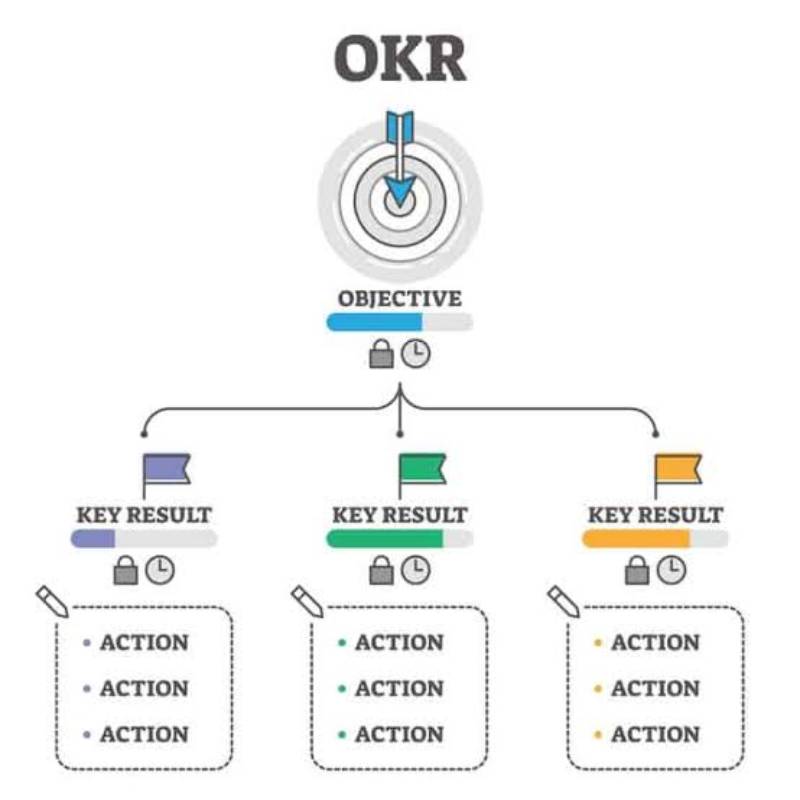
OKR stands for Objectives and Key Results — a goal-setting framework used by businesses, teams, and even individuals to focus efforts on important outcomes and track progress objectively.
-
Objective: A clear, ambitious goal describing what you want to accomplish.
-
Key Results: Specific, measurable outcomes that show whether you’re making progress toward that objective.
The idea is to set meaningful goals and track them with data — not vague tasks or to-do lists.
Why OKRs Matter in Business
OKRs help connect strategy to execution by:
🎯 Creating Focus
You set only a few key objectives each cycle (often 3–5), so teams concentrate on what matters most rather than spreading efforts thin.
📊 Measuring Progress Clearly
Unlike general goals, each Key Result uses measurable metrics (like percentages, counts, or revenue figures) so teams know exactly how close they are to success.
📌 Aligning Across the Organization
OKRs align company, team, and individual goals with the organization’s strategy so everyone works toward shared priorities.
💪 Encouraging Ambition and Innovation
Frameworks like OKRs encourage “stretch goals” — ambitious targets that inspire teams to innovate rather than play it safe.
🔁 Supporting Regular Check-Ins
Teams regularly check progress (often weekly or quarterly), adapt actions when needed, and reflect on results after each cycle.
How OKRs Work (Step-by-Step)
1. Set Strategic Objectives
Start with 1–3 high-level objectives that are qualitative and inspirational — what you want to achieve.
Example:
➡️ “Become the most user-centric product in our category.”
2. Define 3–5 Key Results per Objective
These should be measurable and outcome-focused — how you’ll know the objective was achieved.
Good KRs are specific and quantifiable (e.g., “Increase user retention by 20% in Q1”).
3. Track Progress Consistently
Use regular check-ins (weekly or monthly) and dashboards to update progress against each Key Result.
Some teams score OKRs numerically at the end of each cycle to see how close they came to hitting their targets.
4. Review & Reset
At the end of a cycle (commonly quarterly), teams assess results, learn from what worked and what didn’t, and set the next cycle’s OKRs.
OKR Best Practices
✔ Make objectives inspiring and concise – they should motivate your team.
✔ Use measurable Key Results only – “if it’s not measurable, it’s not a good KR.”
✔ Limit the number of OKRs per cycle – focus prevents overwhelm.
✔ Keep OKRs transparent across teams – everyone should see how their work connects to broader goals.
Example OKRs
Product Team
-
Objective: Improve user engagement this quarter.
-
KR1: Increase DAU (daily active users) by 25%.
-
KR2: Reduce churn rate to less than 5%.
-
KR3: Launch two new engagement-driven features.
-
Sales Team
-
Objective: Grow revenue from new markets.
-
KR1: Acquire 50 new enterprise clients.
-
KR2: Increase average deal size by 15%.
-
KR3: Shorten sales cycle to 45 days.
-
Benefits of Using OKRs
OKRs aren’t just buzzwords — they deliver real business value:
🌟 Clear Direction: Everyone knows what matters most.
🔍 Transparency: Teams understand how their work contributes to goals.
📈 Adaptability: OKRs can be updated as business needs change.
🤝 Better Collaboration: Shared goals bridge functional silos.
💡 Innovation: Stretch targets inspire creative and ambitious thinking.
Who Uses OKRs?
Originally developed at Intel in the 1970s, OKRs were later popularized by companies like Google and have since spread to organizations of all sizes — from startups to Fortune 500 firms.
Today they’re especially common in tech-focused businesses, product teams, and strategy-driven organizations where agility and measurable outcomes are essential.
Final Thoughts: Why OKRs Work Today
OKRs help companies turn ambitious strategic goals into measurable outcomes, bridging the gap between vision and execution. They create focus, clarity, accountability, and alignment — all of which are critical for modern businesses competing in dynamic markets.
Whether you’re setting quarterly goals for your startup or aligning enterprise teams around strategic outcomes, OKRs provide a proven framework for getting results that matter.