
Table of Contents
What Is the Physical Design of IoT?
The physical design of IoT refers to the actual hardware components that make an IoT system work. It includes devices, sensors, actuators, connectivity modules, and the physical layers involved in collecting and transmitting data.
In simple words, the physical design is the “body” of an IoT system. It defines how data is sensed, how devices communicate, and how information moves to the cloud or a gateway. This physical layer works together with logical design and software layers to form a complete IoT ecosystem.
The physical design decides:
– What devices to use
– How data is collected
– How communication happens
– How power is supplied
– How the system interacts with the environment
IoT Devices: Sensors, Actuators, and Controllers
A typical IoT device includes three main physical components:
1. Sensors
Sensors collect real-world data.
Common types include:
– Temperature sensors
– Motion sensors
– Light sensors
– Gas sensors
– Humidity sensors
– Pressure sensors
They help the device understand the environment.
2. Actuators
Actuators perform physical actions based on commands.
Examples include:
– Motors
– Relays
– Valves
– Speakers
– Servo motors
If a sensor “detects,” an actuator “acts.”
3. Controllers (Microcontrollers / Microprocessors)
This is the brain of the IoT device. It processes data and sends instructions.
Popular controllers:
– Arduino boards
– ESP32 / ESP8266
– Raspberry Pi
– STM32
– PIC microcontrollers
Controllers connect sensors, actuators, and communication modules to make a complete IoT node.
Connectivity Options (Wi-Fi, BLE, LoRa, etc.)
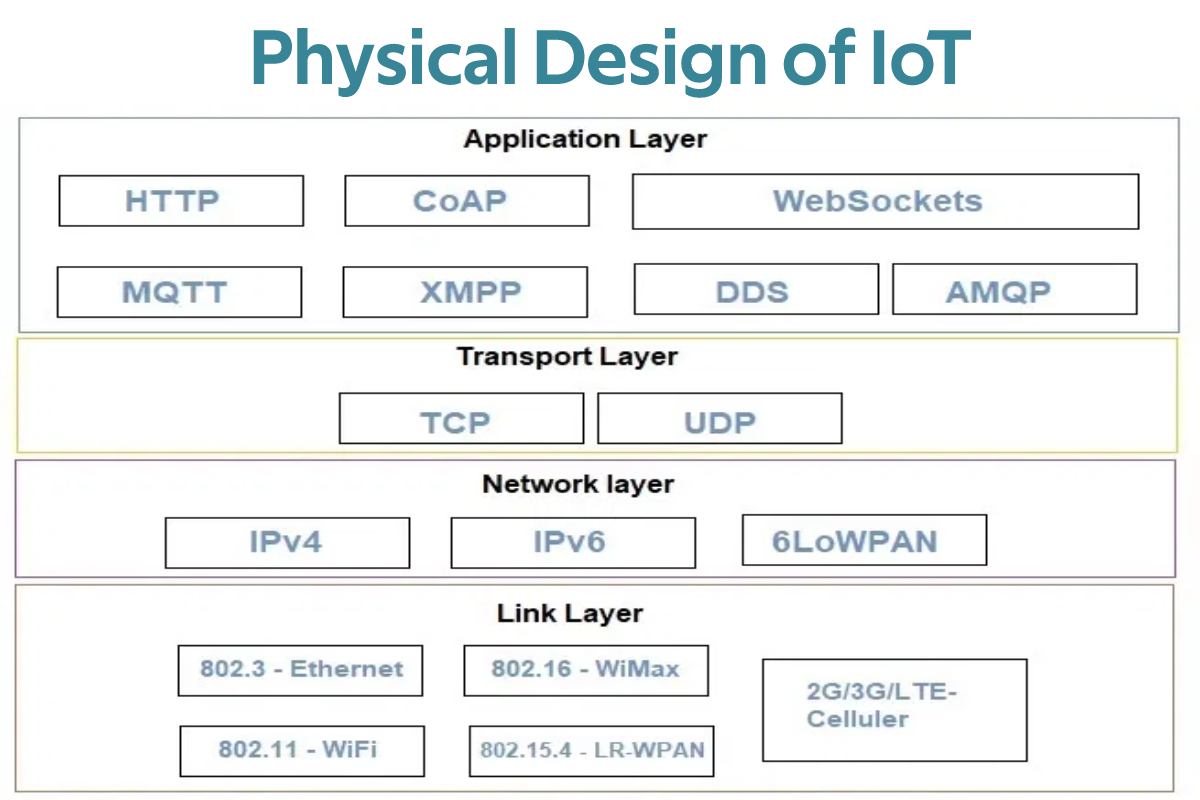
Connectivity determines how IoT devices share data. The choice depends on range, power, and data requirements.
Common IoT connectivity options include:
1. Wi-Fi
– High speed
– Suitable for home IoT and indoor devices
– Higher power consumption
2. Bluetooth Low Energy (BLE)
– Short range
– Low power
– Ideal for wearables and health trackers
3. LoRa / LoRaWAN
– Long-range, low-power
– Best for agriculture, smart cities, remote monitoring
4. Cellular (4G / 5G / NB-IoT)
– Wide coverage
– Good for mobile IoT devices
– Higher cost and power usage
5. Zigbee / Z-Wave
– Low-power mesh networks
– Great for home automation
6. RFID / NFC
– Short-range identification
– Used in access control, inventory management
These technologies ensure IoT devices stay connected and functional in different environments.
Basic Block Diagram of an IoT Device
A simple IoT device generally follows this structure:
Sensor(s) → Controller → Connectivity Module → Cloud / Gateway → User Interface
Breakdown:
– Sensors collect data.
– Controller processes the data.
– Connectivity module sends data wirelessly.
– Cloud or gateway stores and analyzes data.
– User interface displays results through an app or dashboard.
This flow shows how raw data becomes meaningful insights for users.
Choosing the Right Hardware for Your IoT Project
Selecting the right hardware ensures reliability, battery efficiency, and performance.
Factors to consider:
1. Purpose of the IoT device
Is it for monitoring, automation, tracking, or sensing?
2. Environment
Indoor or outdoor? High temperature? Dusty conditions?
3. Power requirements
– Battery-powered
– Solar-powered
– Direct power supply
4. Connectivity range
Short range (BLE) or long range (LoRa)?
5. Data size and frequency
Large data (video) or small intermittent data (sensor readings)?
6. Cost and availability
Choose hardware that is affordable and easy to source.
7. Security support
Hardware must support secure boot, encryption, and firmware updates.
Physical Design Best Practices and Challenges
Best Practices
– Use low-power components for battery-operated devices.
– Ensure proper PCB design for stable signal flow.
– Protect sensors and circuits from dust, heat, and moisture.
– Use reliable connectivity modules to avoid data loss.
– Add fail-safe mechanisms and watchdog timers.
– Test hardware for real-world conditions.
Common Challenges
– Power consumption issues
– Network instability
– Heat management
– Compatibility between sensors and controllers
– Hardware failure due to environmental stress
– Physical security risks
– Limited processing power on small microcontrollers
Addressing these challenges is essential for building scalable and stable IoT solutions.
FAQs on Physical Design of IoT
1. What is physical design in IoT?
It refers to hardware components such as sensors, actuators, controllers, and communication modules.
2. Why is connectivity important in IoT?
Without connectivity, devices cannot send or receive data, making the system incomplete.
3. What is the difference between physical and logical design?
Physical design focuses on hardware, while logical design focuses on data flow, software, and architecture.
4. Which microcontroller is best for IoT?
ESP32, Raspberry Pi, and STM32 are popular choices based on project needs.
5. What protocols are commonly used in IoT?
Wi-Fi, BLE, LoRa, Zigbee, 5G, and RFID.