
Table of Contents
Introduction — Why Social Media Growth Matters in 2026
In 2026, social media isn’t just a distribution channel — it’s a central hub for discovery, engagement, and commerce. Small businesses can now compete effectively with larger brands because:
-
Users spend increasing time on platforms like TikTok, Instagram, YouTube, and WhatsApp for discovery, research, and purchase decisions.
-
Social platforms are evolving into search engines and marketplaces, where users find products and solutions without leaving the app.
-
AI tools democratize content creation and analysis, letting small teams operate efficiently at scale.
🔧 Get your complete technology for business roadmap with tools and strategies here.
Social Media Growth Strategy for Small Businesses in 2026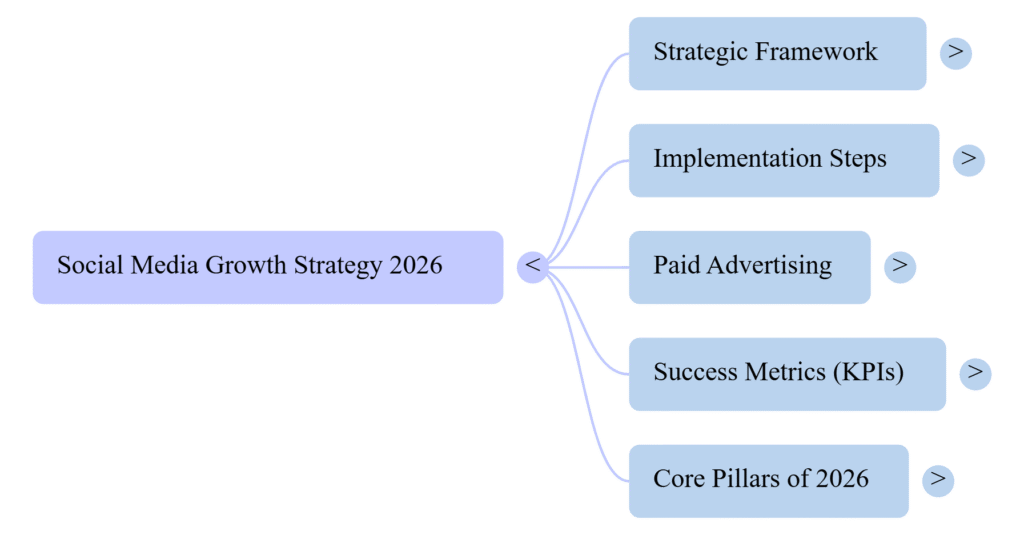
1. Strategic Framework
The strategic framework defines why, where, and how a brand grows on social media in 2026.
Core Focus Areas
-
Audience-first approach: Growth strategies now begin with audience intent, behavior, and platform usage rather than brand messaging.
-
Platform specialization: Businesses perform better when they dominate 1–2 core platforms instead of being present everywhere.
-
Content ecosystems: Every post supports a larger goal—education, trust-building, conversion, or retention.
-
Organic + Paid integration: Paid media amplifies proven organic content rather than replacing it.
Track these results with the right digital marketing KPIs and email strategy – full guide here.
Outreach, Engagement & Market Research
Social media enables direct communication at scale. Use comments, polls, Q&As, and Lives to:
-
Gather feedback
-
Understand shifting customer expectations
-
Monitor competitors
-
Refine product positioning
Market research on social platforms is faster, cheaper, and more real-time than traditional methods.
2. Implementation Steps
Execution in 2026 requires structured, repeatable processes rather than ad-hoc posting.
Step-by-Step Execution
Audience Research & Positioning
- Identify ideal customer segments
- Map pain points, search behavior, and content preferences
Content Planning
- Create platform-specific content calendars
- Prioritize short-form video, UGC, and educational posts
Publishing & Optimization
- Optimize captions for social search (keywords, intent-based phrasing)
- Test formats, hooks, and posting times
Engagement Systems
- Daily comment replies and DM conversations
- Polls, Q&A, and interactive content
Performance Review
- Weekly analysis of engagement and reach
- Monthly optimization based on conversions and retention
3. Paid Advertising as a Growth Accelerator (2026)
| Area | How Paid Ads Accelerate Growth | 2026-Specific Insights | Best Platforms for Small Businesses |
|---|---|---|---|
| Speed to Visibility | Instantly places your brand in front of target audiences | Organic reach continues to decline; paid ads ensure immediate exposure | Meta (Instagram, Facebook), Google Ads, TikTok |
| Precise Targeting | Targets users by behavior, intent, interests, and demographics | AI-driven targeting improves accuracy even with smaller budgets | Meta Ads, Google Performance Max |
| Customer Acquisition | Drives consistent leads and sales | Platforms prioritize conversion-focused campaigns over impressions | Google Search, Instagram Reels Ads |
| Budget Scalability | Allows businesses to start small and scale what works | Smart bidding and AI optimization reduce wasted spend | Meta Ads, TikTok Ads |
| Data & Insights | Provides real-time performance data | Predictive analytics help forecast ROI and customer lifetime value | Google Ads, LinkedIn Ads |
| Brand Awareness | Builds recall faster than organic methods | Video ads deliver higher recall and engagement | YouTube, TikTok, Instagram |
| Remarketing Power | Re-engages visitors who didn’t convert | Retargeting delivers higher ROI than cold traffic | Meta, Google Display Network |
| Local Business Growth | Targets users near physical locations | Hyperlocal and “near me” targeting is stronger than ever | Google Local Ads, Facebook |
| Product Launch Support | Boosts visibility during launches | Short launch windows perform best with paid push | Instagram, TikTok |
| Social Proof Amplification | Promotes UGC, reviews, and testimonials | Ads featuring real customers outperform polished creatives | Instagram, Facebook |
| A/B Testing at Scale | Tests creatives, offers, and messaging quickly | AI automatically prioritizes winning ads | Meta Ads Manager |
| Sales Funnel Acceleration | Moves users faster from awareness to conversion | Full-funnel ad strategies are now platform-standard | Google, Meta |
Why Paid Advertising Matters More in 2026
| Challenge | How Paid Ads Solve It |
|---|---|
| Declining organic reach | Guaranteed reach to ideal audiences |
| Limited marketing teams | AI automates optimization and scaling |
| Budget constraints | Pay only for results (clicks, leads, conversions) |
| High competition | Advanced targeting reduces wasted impressions |
Recommended Paid Ad Mix for Small Businesses (2026)
| Ad Objective | Budget Allocation |
|---|---|
| Awareness & Reach | 20% |
| Engagement & Video Views | 25% |
| Lead Generation | 30% |
| Retargeting & Conversions | 25% |
🔧 Get your complete technology for business roadmap with tools and strategies here.
Track these results with the right digital marketing KPIs and email strategy – full guide here.
4. Success Metrics (KPIs)
Success is measured by impact, not vanity metrics.
Primary KPIs
-
Engagement rate (comments, shares, saves)
-
Video watch time and completion rate
-
Profile visits and link clicks
-
Leads, inquiries, or purchases from social
Secondary KPIs
-
Follower growth quality
-
Cost per lead (for paid campaigns)
-
Retention and repeat engagement
-
Community interaction depth (DMs, replies)
5. Core Pillars of 2026
Social media growth in 2026 stands on five foundational pillars:
-
-
Authenticity
-
Real stories, real people, real experiences
-
-
Short-Form Video Dominance
-
Reels, Shorts, TikToks as primary discovery tools
-
-
AI-Assisted Execution
-
AI for ideation, optimization, and analytics—not replacement
-
-
Community-Centric Growth
-
Conversations outperform broadcasts
-
-
Social Commerce & Search
-
Platforms act as search engines and marketplaces
-
-
FAQs: Social Media Growth for Small Businesses
How long does it take to see growth on social media?
Typically 60–90 days with consistent posting and engagement.
Is paid advertising necessary?
Not mandatory, but it accelerates results when paired with organic content.
Which metric matters most for small businesses?
Leads, link clicks, and conversions—not follower count.
Can one person manage social media effectively?
Yes, with a focused platform strategy and repeatable content system.
Final Takeaways for Small Businesses
✅ Social media success in 2026 is about relevance, not reach. Small, engaged communities beat large but passive ones.
✅ AI and automation are no longer optional — they are essential tools to scale smartly.
✅ Short-form video + UGC + social SEO are the pillars of growth this year.
By combining authentic content, smart use of AI, community engagement, and commerce-ready tactics, small businesses can generate sustainable growth, even with limited budgets.